

“Hey Victor, we are cancelling your book, you will get an email.”

Emails like this are never easy to deal with. If you’ve followed some of my work, you’d know that I had started writing a book on multi-agent systems. I started working with Manning Publications in early 2024, and in July of that year I announced that the book was in early access through their MEAP (Manning Early Access Program).
I had a book cover. A discount code. Marketing plans. All the good stuff.
Fast forward to July 2025 — I got the email above. The book got cancelled.

Four months later, the book is now published — a #1 New Release on Amazon, #5 Best Seller in Generative AI as at time of writing this. The book went from 4 uploaded chapters (at time of cancellation) to complete - 15 chapters, 56,000+ words, 186 code snippets, and 51 hand-drawn figures.
Digital edition : https://buy.multiagentbook.com/
Print edition on Amazon: https://www.amazon.com/dp/B0G2BCQQJY
Here’s what happened.
How Does A Book Get Cancelled?
The short story is that .. life happened. And also, the process wasn’t working for me. Here’s the timeline:
January 2024: Contract signed with Manning.
May 2024: I fractured my wrist. A bad fall, surgery, titanium plates with screws, recovery. This is where things slowed down. Beyond the physical recovery, for a researcher or software engineer, there’s the worry about how an injury might affect your career. Luckily, I’ve made a good recovery.

July 2024: MEAP (early access) launched with the first two chapters.
Sept 2024 – Jan 2025: The AutoGen rewrite. This was an especially busy time at work — AutoGen was rewritten with a completely new API (released Jan 2025). I contributed to the AgentChat API, which eventually became the format that other frameworks (Google ADK, OpenAI Agents SDK) converged on, and I rebuilt AutoGen Studio on this new version. This created a problem for the book: code in chapter 1 was already obsolete before I finished chapter 2. I realized that writing a book tightly coupled to a specific framework version was a trap. I originally had a co-author, but by the time of cancellation, I was writing alone.
For new readers, I am a core maintainer of AutoGen and have written extensively about it and agents in general.
July 2025: Cancelled. I had written 4 chapters and uploaded them to the Manning platform. But that pace was understandably slow for the publisher. They chose to cancel.
Throughout this period, I was writing — but the upload and review cycle wasn’t working for me. Every change to the table of contents had to be approved. The Manning internal review process brought feedback that often felt disconnected from improving the book. Weekly meetings with the editor ate into writing time. I spent energy conforming to the process when I should have been creating.
It took the cancellation to isolate this observation: the lack of creative control was itself a blocker. For me.
Getting Back on Track
The cancellation forced me to rethink what was going wrong. My wife pointed out something I probably knew was true — she’d seen me hammer out book-quality writing in the form of blog posts late at night during this same period (see this substack). Writing wasn’t the problem. The process was.
Luckily, it was a clean break. I hadn’t collected my advance, so all rights for written material returned to me.
I decided to focus on why I had started writing in the first place:
There are many users new to AI who need structured guidance, not just material scattered across papers, blog posts etc.
Long-form content and a guided teaching experience is still critical — even though deep research agents can find you whatever you want, it won’t be in a coherent, graduated progression
There is lots of noise — new stuff every day — but there are principles and patterns that will endure
There is value in understanding the nuts and bolts of agents and how to build them from scratch
I renamed the book — “Designing Multi-Agent Systems” instead of “Multi-Agent Systems with AutoGen.”
I revamped the direction. The pivot to building from scratch turned out to be the strongest choice I could have made. The book would have been problematic if it stayed tied to AutoGen — changing the title would have been impossible (or very challenging) with Manning, and the content would age poorly. Instead, the new approach lets readers take ownership: if concepts change (as they inevitably will), readers are equipped to adapt because they understand the underlying principles.
The time I would have spent fighting with Manning’s tools and review process went instead toward the reader experience: crafting a coherent learning progression, building PicoAgents from scratch (it’s a real library on PyPI), creating a one-click Codespaces testing environment, and building an extensible platform where readers get the digital book plus optional end-to-end samples that will grow over time.

I also built a self-publish pipeline. I built buy.multiagentbook.com from scratch — customer dashboard, payment processing, download management for the digital version of the book. (I plan to write about the technical details in a Part 2 post!). Print is managed by a separate entity - Amazon’s KDP service - and the sheer amount of what I had to learn to get all this done - type setting, bleeds, font and readability effects, cover design to meet specs - all a different story for another day!
Self-publishing gave me things I didn’t realize I was missing:
Full creative control. I could add the Responsible AI chapter without arguing for it. I could structure the book my way.
Tools I was excited about. Quarto instead of AsciiDoc. Hot reloading. Multi-format output from a single source.
Control over updates. With Manning, any update could take weeks. With my platform, it takes 5 minutes. Fun fact - I wrote big chunks of the book and released them whilst waiting at a cafe for my 6yr old to finish gym class.
Control over distribution. Technical books can be like cars — 30% outdated the moment they’re in print. The only chance I had to fight this was a framework-agnostic rewrite, a living distribution method, and building a direct connection with readers.
Higher royalty share. Self-publishing means keeping a larger percentage of each sale, which helped offset the effort of building my own platform. Most authors of technical books will (correctly) tell you the proceeds rarely justify the hours. But if you’re going to do it anyway, know that traditional publisher royalties are typically 10-15%, while self-publishing through your own platform (Stripe, etc.) can be 85-95%, and print-on-demand (KDP, IngramSpark) falls somewhere in between at 35-60%.
The Result

Between July and November 2025, I put it all together. I had done large chunks of the work (some sections already written on this substack actually), just in bits and pieces - eval code in many places, workflows, sample apps. I used the time after the cancellation to consolidate and finish.
The book released in November 2025:
15 chapters
56,000+ words
186 code snippets
51 figures and diagrams (all hand-drawn by me)
~400 pages
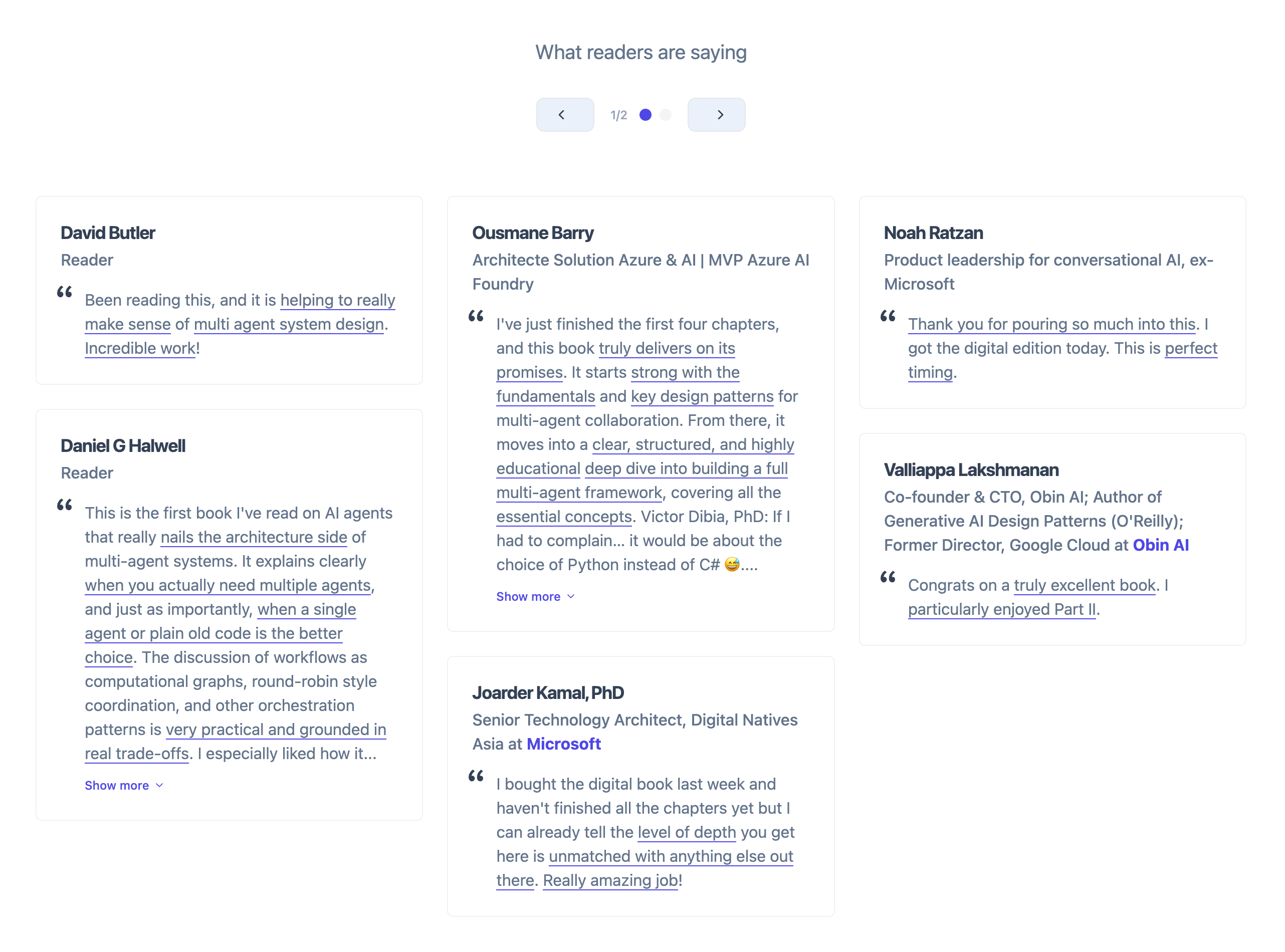
It hit #1 New Release in the Generative AI category on Amazon and stayed there for 4 weeks. 100s of copies sold (thank you!)
What I’d Tell Myself If I Started Over
Know your working style. Traditional publishing works well for many authors — Manning has published excellent books. But if you need creative control and fast iteration, the friction will slow you down more than you expect.
Publishers optimize for process, not necessarily your vision. Approvals, reviews, and meetings exist for good reasons — but editorial feedback isn’t always from subject matter experts. I found myself spending energy debating suggestions that didn’t improve the book. Towards the end, I realized our goals had diverged: they needed to ship books on schedule; I wanted to craft a learning experience I was proud of.
Self-publishing is viable — but only if you build systems. I spent significant time on infrastructure (payments, hosting, distribution). If you’re not willing to do that, platforms like Gumroad or Leanpub are reasonable alternatives.
The book you finish is better than the book you planned. The cancellation forced a rewrite that made the book framework-agnostic and more durable. Sometimes constraints are gifts.
The Hard Part
Where did I find the time? The honest answer: I didn’t really have it. July through November were long days — early mornings, late nights, weekends, very little sleep. This has been one of the hardest things I have done (since finishing my PhD).
I want to thank my wife and son for their incredible support. Their love, hugs, and being there for me made this book as much theirs as it is mine.
That cancellation email? It gave me the book I was trying to write all along.
Part 2 of this story: I Built My Book’s Entire Distribution Platform for $5/Month — the technical details of building buy.multiagentbook.com from scratch. Coming soon!
Links:
Designing Multi-Agent Systems — the book
multiagentbook.com — marketing site
Amazon (print editions) — paperback and hardcover
P.S. If you got the book and have comments of feedback, please share them here!
Also, if you could leave a review, it goes a long way in making the book more visible!
Goodreads https://www.goodreads.com/book/show/243940144-designing-multi-agent-systems
Amazon https://www.amazon.com/review/create-review/?ie=UTF8&channel=glance-detail&asin=B0G2BCQQJY
Interested in learning about translation right? Please send an email to support@multiagentbook.com to learn about copyrights and legal requirements.
I love this and I'm glad it worked out. It happened how it should have to get the book you wanted.