

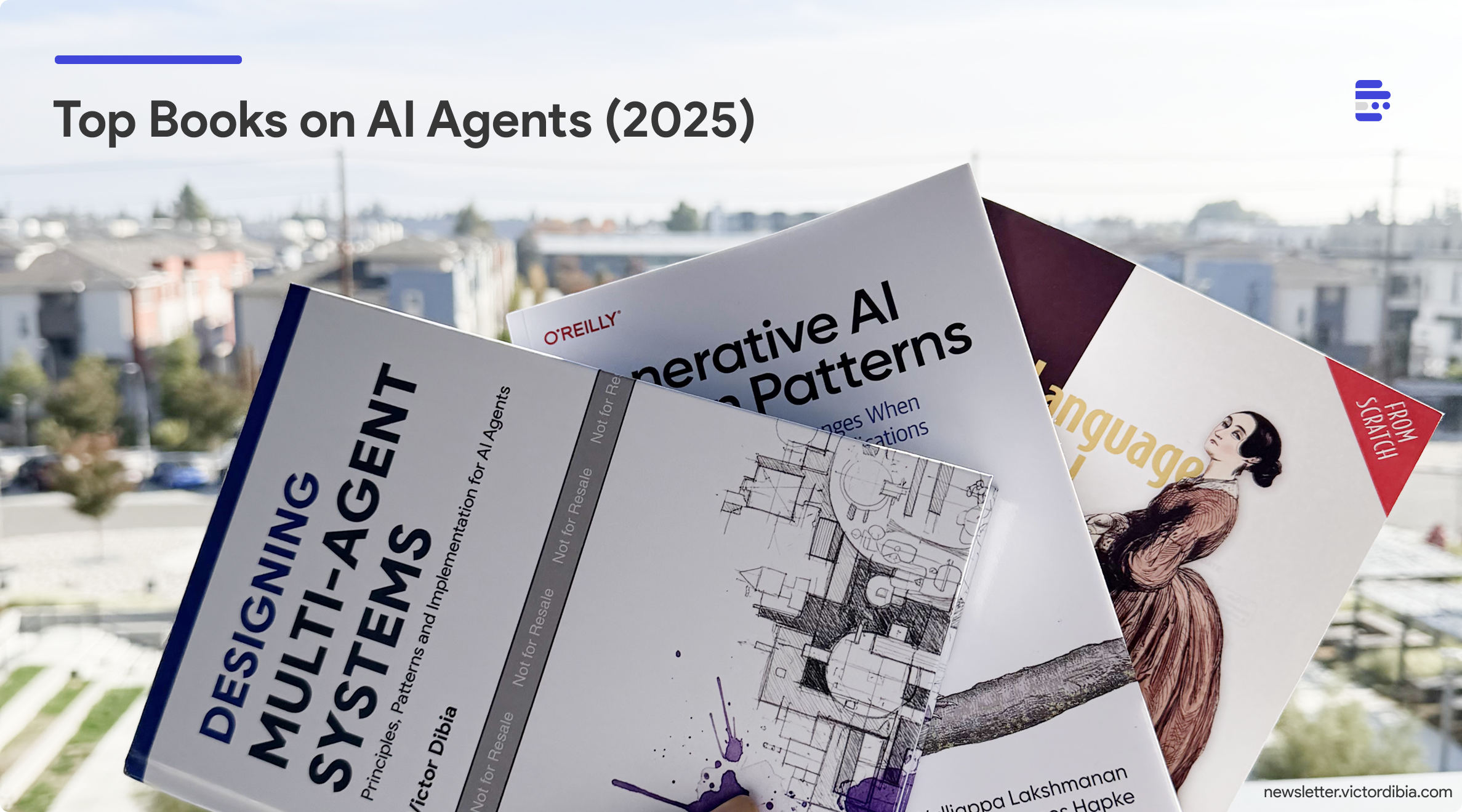
I spent some time over the last two years writing a book on multi-agent systems. Along the way, I read as much as I could find on the topic.
Get the book here (Digital version with samples | Print version on Amazon)
2025 has been heralded as the year of agents. Beyond the hype, building applications that integrate agents is becoming a widely useful skill. Books that help provide a curated learning path can be valuable in helping you get started.
Naturally, given how early the AI agent approach is, there aren’t many books specifically about AI agents yet. Most “AI” books focus on machine learning fundamentals or LLM prompting. Agent-specific content tends to be scattered across blog posts, framework documentation, and research papers.
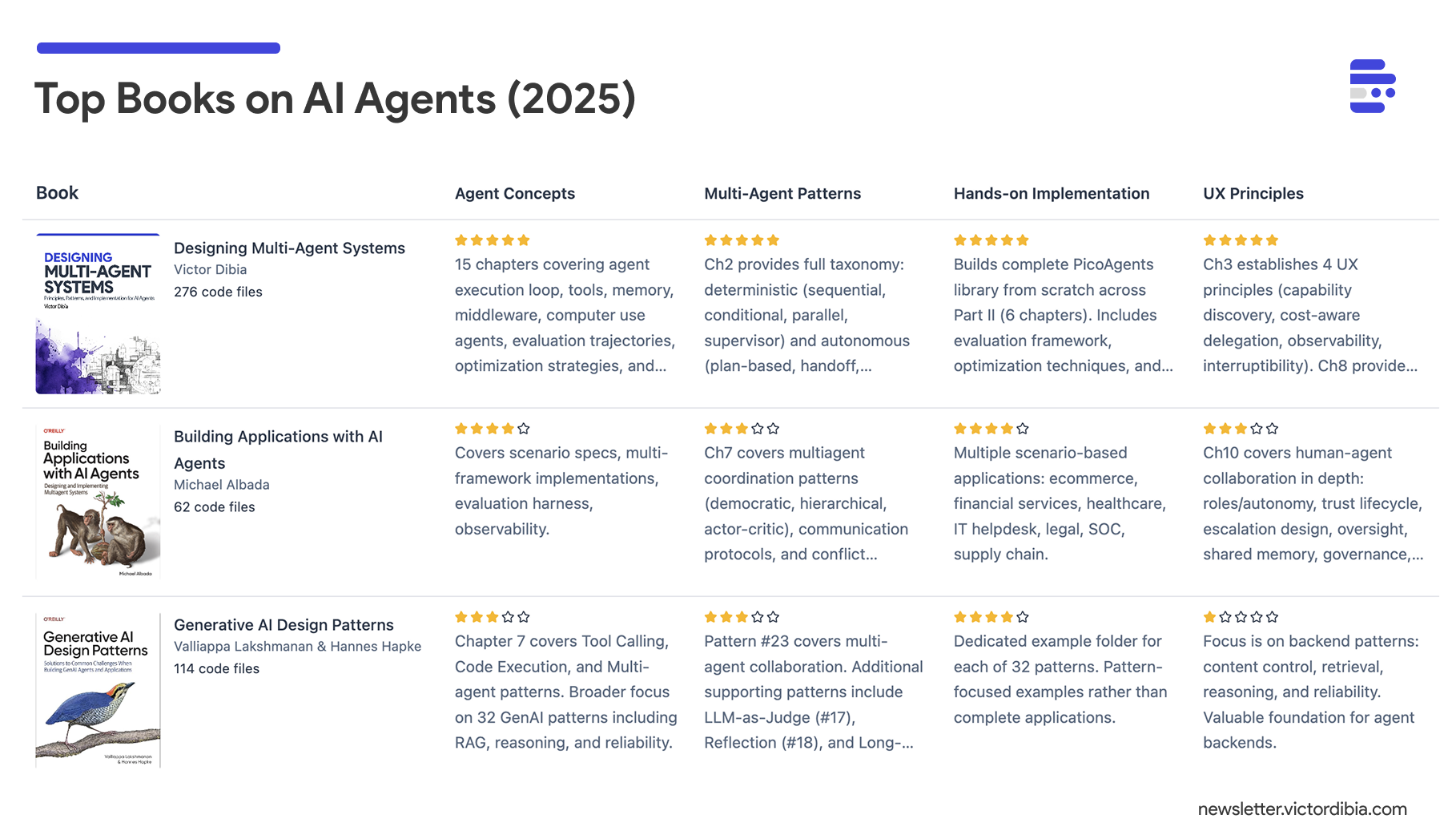
But a few books stand out. I’ve reviewed them based on four dimensions that matter for learning to build agents:
Agent Concepts: Tools, memory, orchestration, observability
Multi-Agent Patterns: Coordination, handoffs, team structures
Hands-on Implementation: Runnable code, complete applications
UX Principles: Streaming, human-in-the-loop, interfaces
Disclosure: I wrote one of these books and the selection here is my opinion. I’ll be upfront about that and let you decide what’s useful. I also created an interactive page here as more books become available.
The Books
1. Designing Multi-Agent Systems
Author: Victor Dibia. Year: 2025
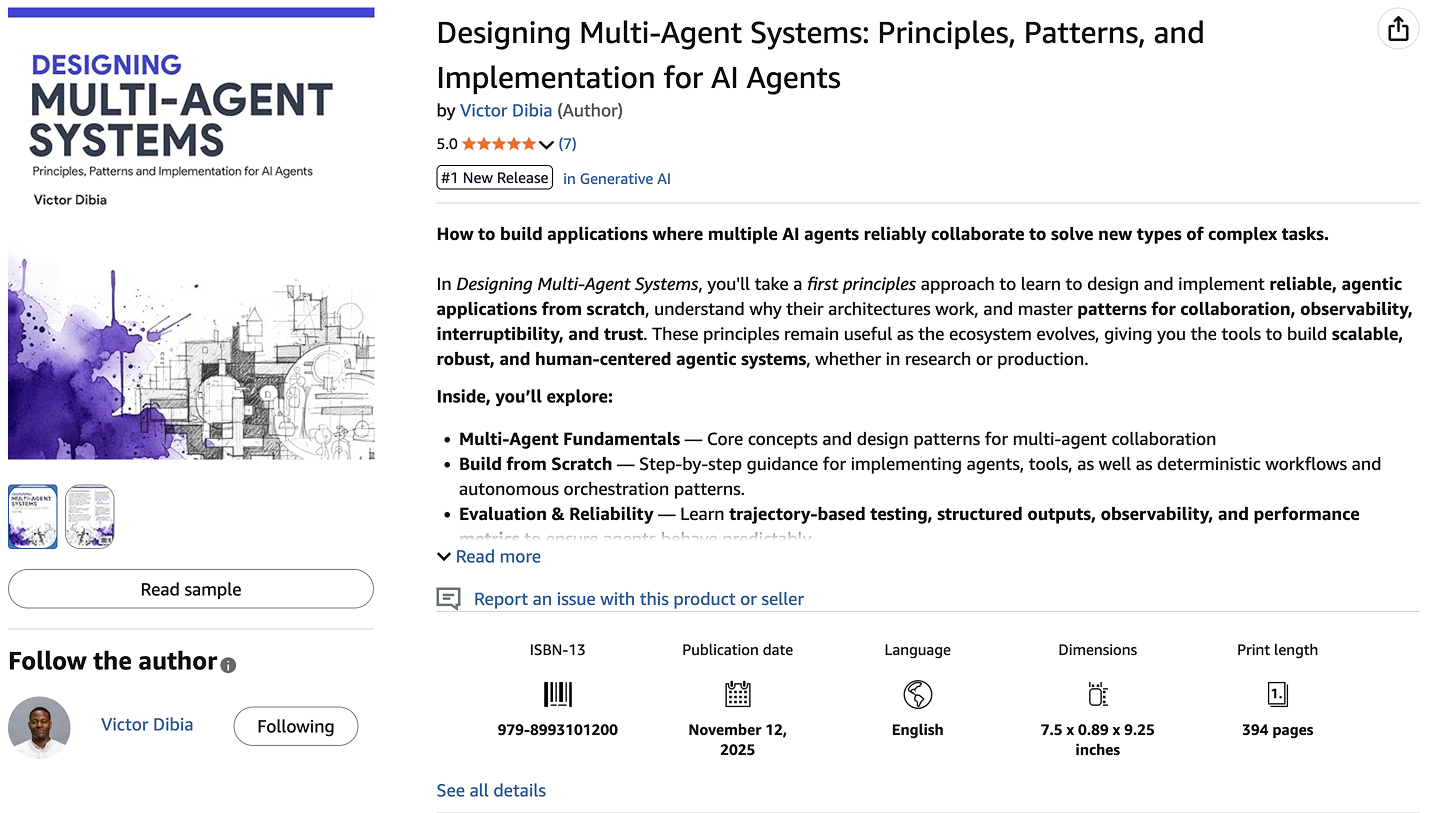
I wrote this book, so I’ll keep the summary brief and let you judge.
What it covers: 15 chapters across 4 parts. Part I establishes theory—6 orchestration patterns (sequential, conditional, parallel, supervisor, handoff, conversation-driven) and 4 UX principles (capability discovery, cost-aware delegation, observability, interruptibility). Part II builds a complete agent library (PicoAgents) from scratch, including computer use agents, deterministic workflows, and autonomous orchestration. Part III covers evaluation with trajectories and LLM judges, 10 failure modes, MCP/A2A protocols, and ethics. Part IV provides two full case studies (business Q&A from unstructured data, software engineering agent).
Unique angle: Framework-agnostic. Instead of teaching you LangChain or CrewAI, it teaches the patterns those frameworks implement. You build everything from first principles. For completeness, the book’s GitHub repo also contains examples of the same concepts implemented using the Microsoft Agent Framework (successor to AutoGen and Semantic Kernel), Goole ADK, and LangGraph.
Best for: Engineers who want to understand multi-agent systems deeply, not just use a framework.
Links: Amazon | GitHub | multiagentbook.com
2. Generative AI Design Patterns
Authors: Valliappa Lakshmanan & Hannes Hapke Year: 2025
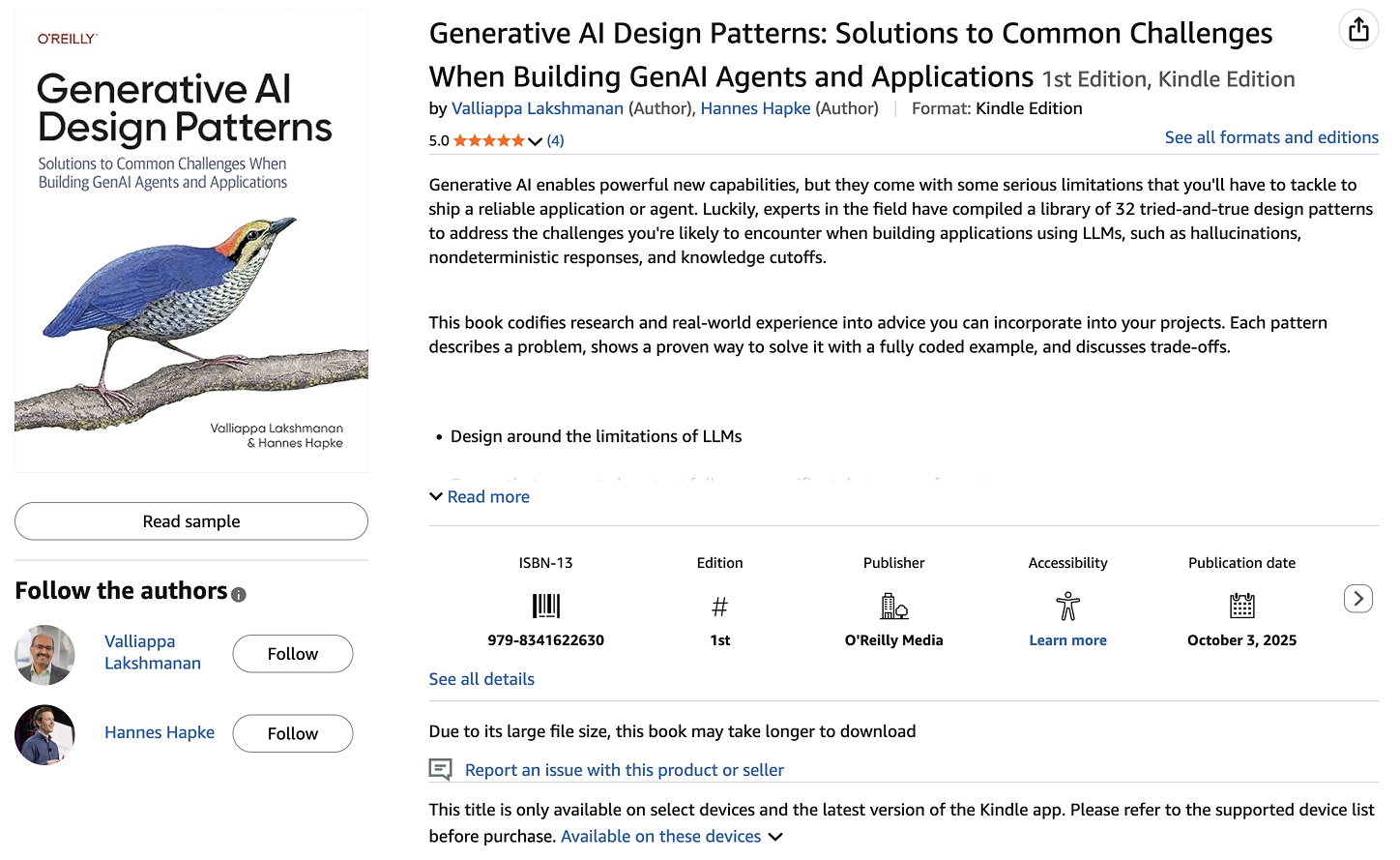
What it covers: 32 design patterns for generative AI in a structured problem/solution format. Chapter 7 covers agent-specific patterns (Tool Calling, Code Execution, Multi-agent), but the book’s real strength is the other 31 patterns: content control, RAG, reasoning (Chain-of-Thought, Tree-of-Thought), reliability, guardrails.
Why it’s valuable for agent builders: Agents are built on top of these patterns. Understanding RAG, structured output, and reliability patterns gives you the building blocks agents use internally. Pattern #23 covers multi-agent collaboration specifically.
Limitation: Not fully agent-focused. Also, If you want deep coverage of orchestration patterns or agent UX, look elsewhere. But as a companion to agent-specific resources, it’s excellent.
Best for: ML engineers who want broad GenAI pattern coverage, with agents as one component.
3. Building Applications with AI Agents
Author: Michael Albada Year: 2025
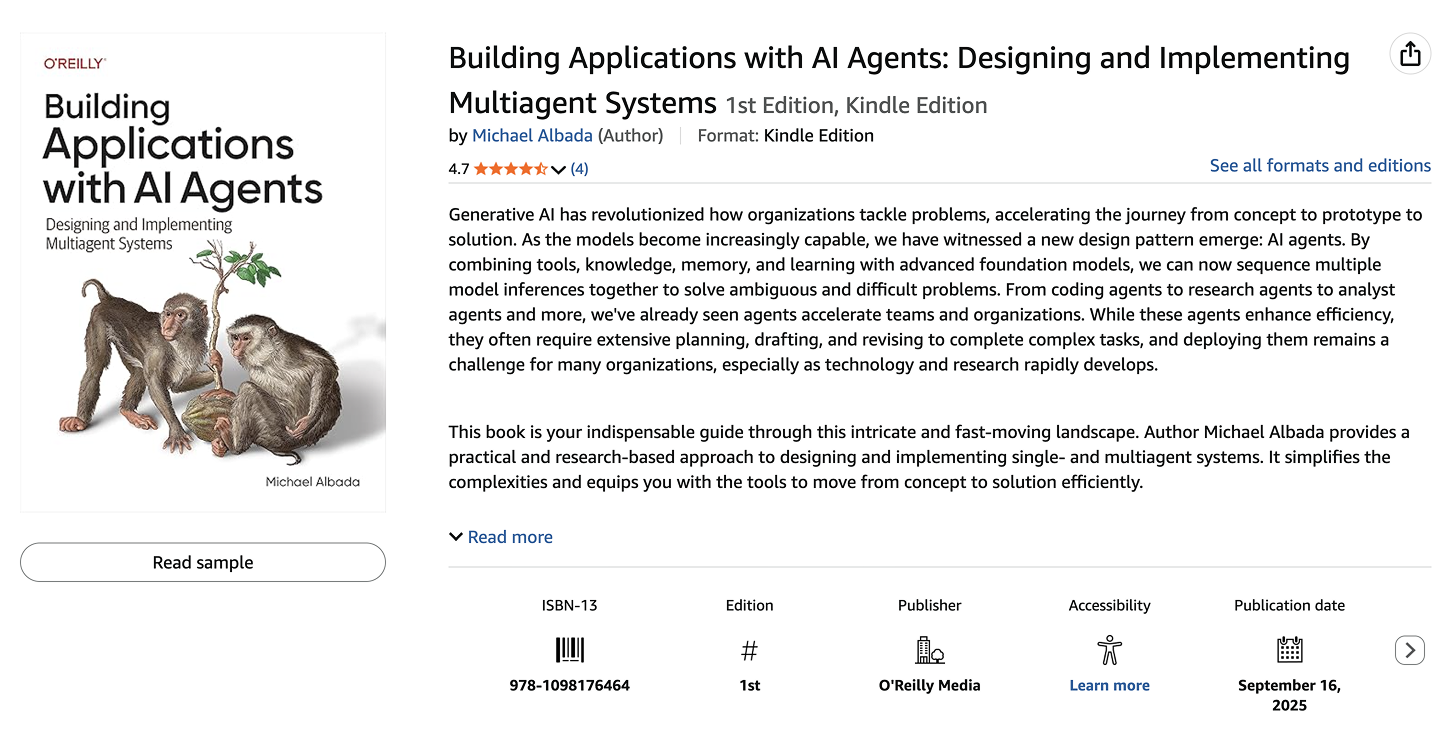
What it covers: A solid introductory resource for folks new to AI agents. Notably covers human-agent collaboration and agent interface design (Chapter 3), plus model improvement techniques (finetuning, SFT, DPO, RL) in Chapter 7. Implements a few scenarios across three frameworks: LangGraph, LangChain, and AutoGen.
Unique angle: Framework comparison. If you’re trying to decide between LangGraph, LangChain, or AutoGen, seeing the same scenario implemented in each helps you understand the trade-offs. Includes industry scenarios: ecommerce, financial services, healthcare, IT helpdesk, legal, SOC, supply chain.
Limitation: Framework-specific code may become outdated given rapid framework evolution.
Best for: Developers interested in an introduction to general agent concepts, and use of agent frameworks, teams new to AI agents.
4. Build a Large Language Model (From Scratch)
Author: Sebastian Raschka Year: 2024 Code: 177 files (122 Python + 55 notebooks)
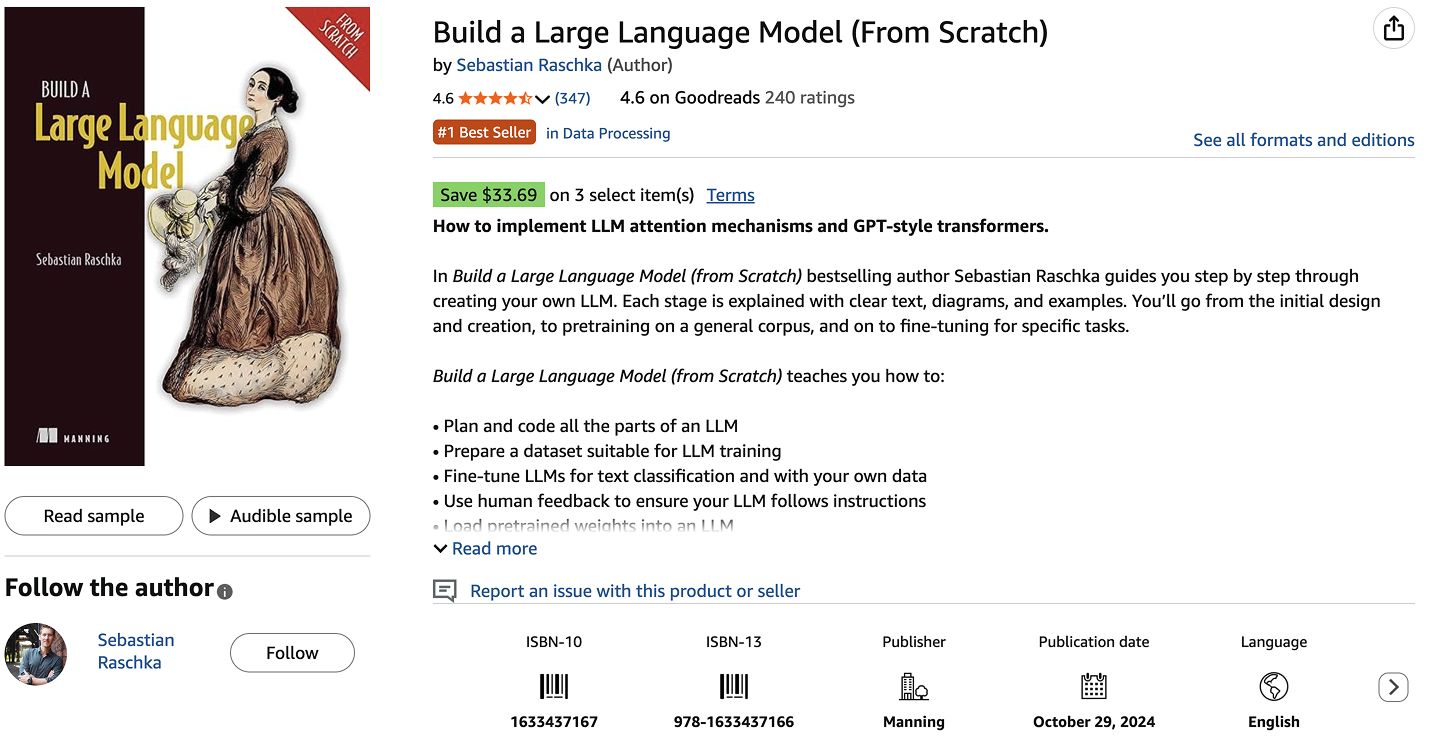
What it covers: Admittedly this book is not about AI agents per se but useful for understanding LLMs work by implementing them from scratch. Attention mechanisms, tokenization, pretraining, finetuning, LoRA. Builds a GPT-like model step by step. Includes bonus implementations for Llama 3.2, Qwen3, and Gemma 3.
Why include a non-agent book? Because agents call LLMs under the hood. When your agent behaves unexpectedly, understanding attention patterns and token limits helps you debug unexpected behaviour. When you’re optimizing token usage or choosing between models, knowing what’s happening inside matters.
Limitation: No agent content. This is pure LLM internals.
Best for: Engineers who want to understand what agents are calling, not how to build agents themselves. A lot of folks find this book useful for preparing for ML engineering interviews where definitions and low level implementation is part of the interview process.
How I Evaluated These Books
I evaluated each book by reviewing its table of contents for topic coverage and its GitHub repository for implementation depth (file counts, whether code builds complete applications vs. isolated snippets). Here’s how I mapped the four dimensions:
Agent Concepts: Tools, structured output, orchestration, observability, memory, planning
Multi-Agent PatternsSupervisor, swarm, handoffs, conversation-driven orchestration, workflows
Hands-on ImplementationPython + notebook file count, end-to-end applications vs isolated snippets
UX PrinciplesStreaming, human-in-the-loop, error handling, interface design chapters
Data collected from each book’s GitHub repository (November 2025).
Scope
This is a curated list, not an exhaustive one. I’ve excluded framework-specific books (LangChain, CrewAI) since their APIs change frequently enough that printed content dates quickly. Online courses and research papers are also out of scope here. If you think a book belongs on this list - open an issue.
Which Book Should You Read?
To understand and build agents: Designing Multi-Agent Systems (my book) builds from first principles.
For broad GenAI patterns: Generative AI Design Patterns covers 32 patterns including RAG and reasoning.
An overview of agents with comparisons across frameworks: Building Applications with AI Agents implements the same scenarios in LangGraph, LangChain, and AutoGen.
To understand the LLM layer: Build a Large Language Model (From Scratch) teaches what agents call under the hood.
Some links are affiliate links.
Data last updated: November 2025
I would also recommend “Building Reliable AI Systems” by Manning Publications